Updated 02:41 PM,Aug 26,2017
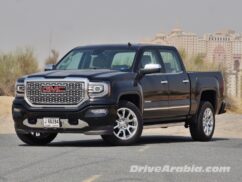
For decades, the Ford F-150 has led in sales across the American market, but in the Middle East region, it is outpaced by Chevrolet Silverado and GMC Sierra. General Motors’ twin trucks have experienced some confusion since their 2014 redesign, mainly due to insufficient dramatic updates compared to earlier models. As a result, these vehicles underwent a secondary improvement in 2016, including the top-tier model, the GMC Sierra Denali, which aims to be the most luxurious pickup truck you can purchase.
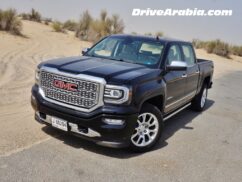
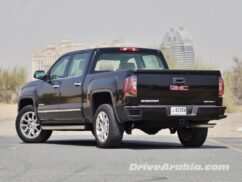
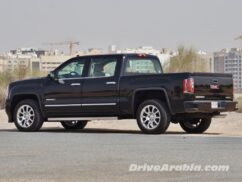
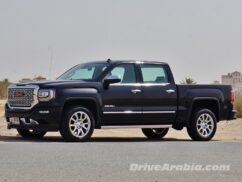
Following this update, the GMC Sierra 1500 received a larger grille and additional LED exterior lighting while retaining its signature chrome-finished brand grille. It also features body-colored bumpers, shiny 20-inch alloy wheels (22 inches available as an option). This is a large, imposing vehicle that stands out on crowded streets next to smaller cars, yet still maintains a refined appearance among competitors like the Ford F-150 and Ram 1500. The Denali features a single exhaust pipe similar to the F-150, though it lacks the striking dual exhaust of the Ram Laramie. When the large doors open, side steps automatically extend, making entry easier even for shorter individuals. Inside, the Denali’s cabin resembles the Chevrolet Silverado’s in general layout, though only in broad design terms.
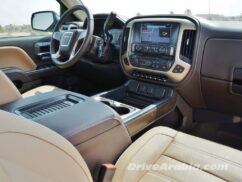
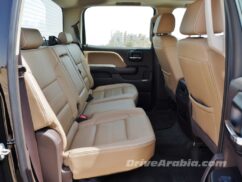
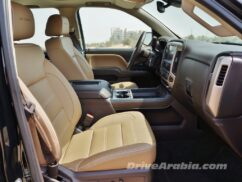
While the standard Denali trim is largely composed of hard plastics, higher trims include wood and aluminum accents, a soft-touch dashboard with embroidered leather upholstery, padded door and window sills, and fully lined doors with glove compartments. However, the rear window sills remain made of hard plastic. With numerous advanced features and a vibrant touch screen, the interior feels more like a premium SUV than a work truck—except for the traditional column-mounted shifter, a feature General Motors continues to favor excessively. There is ample space, with large front and rear seats, and abundant storage options, including a hollow compartment between front passengers thanks to the space freed up by the column shifter. Multiple cup holders, pockets, and small storage areas are also present. A hidden storage area lies beneath the rear seat, though there are no under-floor compartments like those found in the Ram. At the back, the Denali boasts a spacious cargo bed with the name “Denali” engraved into the tailgate, plus corner trays to assist loading. An optional tailgate cover is required if you wish to store valuable items securely inside.
Technology and connectivity features are extensive, including an 8-inch touchscreen with voice command support, memory card slot, Bluetooth, multiple USB ports, a premium sound system, Apple CarPlay, a rearview camera, and a color display integrated into the instrument cluster. Additional features include heated and ventilated front seats with 12-way power adjustment, a heated steering wheel, forward and rear parking sensors, full LED lighting for headlights and cargo area, a sunroof, excellent dual-zone climate control, keyless entry, and more. However, smart keys, a push-button start, a panoramic glass roof, and rear air vents are absent—features already included in the top-tier Ford F-150 and some found in the Ram 1500. The Denali’s unique standout feature is the smartphone wireless charging pad mounted on the center armrest.
Safety and security features meet modern standards, including side curtain airbags and front airbags, ABS and ESP systems, and an optional Driver Attention Assist package that adds features such as low-speed automatic braking, lane-keeping assistance, dynamic lighting, and a smart seat alert system that vibrates the driver’s seat when warnings from other systems are triggered.
The standard Sierra comes with a 5.3-liter V8 engine producing 355 horsepower and 519 Nm of torque, but our test vehicle—the Denali—features a 6.2-liter V8 shared with the Cadillac Escalade. Paired with a smooth eight-speed automatic transmission, this powerful engine delivers 420 horsepower at 5,600 rpm and 623 Nm of torque at 4,100 rpm. As a 4×4 model, the Denali can switch between two-wheel and four-wheel drive modes and includes low-range gearing. We recorded a 0 to 100 km/h time of 7.5 seconds, with a sudden surge in acceleration occurring at high engine speeds.
Fuel consumption is high when driving aggressively, but at a steady 120 km/h—allowing the cylinder deactivation system to function—we achieved a respectable fuel economy of 14.5 liters per 100 km (6.9 km per liter). Thanks to its adaptive magnetic suspension, the Denali offers a smoother ride than the standard Sierra, though its springs remain slightly firm, preserving the vehicle’s original independent frame-based structure. Vibrations persist on rough roads but are less harsh than before, making it sufficiently comfortable for daily driving. On highways, it remains remarkably quiet. It doesn’t exhibit any significant handling issues compared to more off-road-oriented models.
The body roll is greatly reduced compared to previous versions. The Denali handles corners with stability and good speed, offering excellent body control during sudden direction changes. The onset of oversteer is predictable at the limits of grip, and during regular driving, the tires—measuring 275/55—provide outstanding traction. Steering is light and somewhat vague, but surprisingly, it delivers a satisfying level of responsiveness. Braking performance is strong, with effective stopping power.
While visibility is generally good thanks to the rearview camera and large mirrors, the most pressing practical concern is maneuvering the Sierra into tight underground parking spaces or narrow spiral ramps. We did not test the Sierra on rough terrain, but it should handle moderate inclines with ease. However, it cannot clear steep sand dunes without risking damage to its underbody skid plate or tearing its low front bumper—designed to improve aerodynamics and reduce fuel consumption.
The GMC Sierra Denali is an excellent cargo hauler and leads its class in interior material quality. While it represents a significant upgrade from older General Motors offerings, several key technological features are missing, making it less appealing than competing American pickups at the same price point. That said, if you don’t require features like turbocharging or electronic shifting, and you rarely park in tight spots, the Sierra can serve as a capable daily driver with added value in towing and hauling capacity when needed.
To read the English driving experience by Moshref Hussein, click here.
For the latest prices and specifications, visit the GMC Sierra Buyer's Guide.