Updated 01:17 AM,Sep 29,2016
It hasn’t been long since the Ford Ranger WildTrak arrived, yet it has already sparked debate—largely due to its diesel engine. Despite visual updates, its strong resemblance to other commercial variants didn’t help its appeal. With diesel car prices dropping significantly, Ford decided to refresh the 2016 WildTrak model in an effort to make it more attractive.
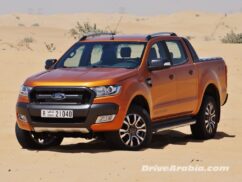
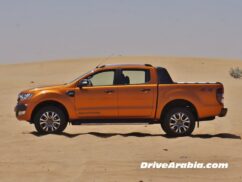
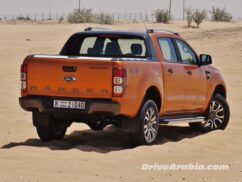
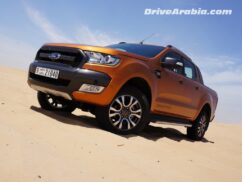
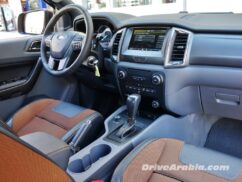
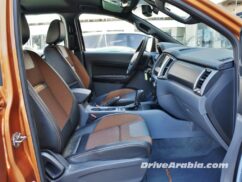
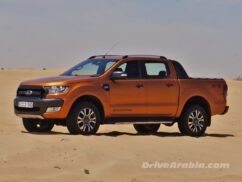
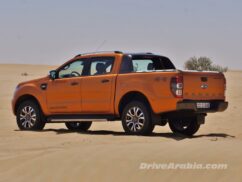
The exterior changes for the 2016 WildTrak included a major redesign of the front end, making it more aggressive and visually striking compared to its peers, drawing closer in appearance to the latest Ford Edge. The side and rear profiles retained the previous model’s design. We drove a WildTrak in vibrant orange, a color that feels unusual yet exciting for a pickup truck. The exterior paint matches the standard leather-trimmed interior in the same bold orange tone. Synthetic leather stitching appears on the upper dashboard and door panels, though much of the cabin still features hard plastic elsewhere. The central control unit features a 6.2-inch touchscreen displaying the familiar SYNC 2.0 interface, with a refreshed menu layout. The instrument cluster includes two colorful LCD screens flanking the speedometer, a feature common across many Ford models. The seats boast a coordinated blend of orange and black leather upholstery, moderately padded and ventilated, with sporty “WildTrak” branding. The vehicle also comes equipped with several tech features, including blind-spot monitoring, dual-zone automatic climate control, automatic headlights and wipers, a self-dimming mirror, six airbags, and more.
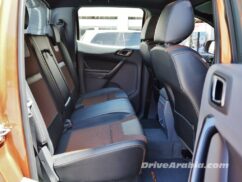
The cabin offers generous front and rear space, with both overhead and underfloor storage areas well-utilized. Rear seating is less upright than in most competitors within this segment. The air conditioning proved powerful even during April’s warm weather, effectively cooling the cabin despite limited rear vents. There are ample cup holders for front and rear passengers, glass bottle holders in the front doors, and multiple storage compartments—including a hidden compartment beneath the rear seats. A 12-volt outlet and a 110/240V power socket are available for rear passengers. A metal-enclosed cover protects the large cargo box.
One standout feature of the Ranger WildTrak is its 3.2-liter five-cylinder turbocharged diesel engine, producing 197 horsepower at 3,000 rpm and 470 Nm of torque at 1,500 rpm. Paired with a smooth six-speed PowerShift transmission, it accelerates from 0 to 100 km/h in just 9.8 seconds. The larger turbo from the previous model has been replaced with a smaller one offering higher boost pressure, virtually eliminating turbo lag. The manual mode of the automatic transmission responds quickly and shifts smoothly, maintaining engine revs even near redline without unnecessary upshifts. The gearbox precisely selects the right gear during slow city driving. Overtaking on open roads is effortless and requires no downshifts, thanks to the abundant torque delivered by the diesel engine. Fuel consumption remains economical when compared to similarly sized gasoline vehicles. The odometer recorded 9 liters per 100 km under various driving conditions, including light off-road terrain.
As noted earlier, the WildTrak’s ride quality is noticeably firm, primarily due to the suspension setup. Initially, we suspected overinflated tires, but confirmed they were properly inflated to only 32 psi. Handling is surprisingly good for a pickup truck—body roll is minimal, and grip on the road is solid. The electronically assisted steering delivers helpful feedback and contributes to a tight turning radius, allowing agile and responsive cornering. Visibility is generally good in all directions, and a rearview camera aids parking in tight spaces. However, the vehicle does produce more noise than expected on highways, mostly from the engine.
With its part-time four-wheel drive system, the WildTrak performs efficiently on rough terrain. It features a shift lever with three modes: 2 High, 4 High, and 4 Low. Lacking a center differential means full four-wheel drive isn’t always beneficial, so driving in rear-wheel mode is recommended on paved roads. Optional features like a rear differential lock and hill descent control were missing from our test vehicle. Still, we didn’t need them, as our route was limited to moderate sand dunes.
Nonetheless, the Ranger WildTrak proves to be an excellent on-road capable pickup, concealing significant untapped potential. It boasts excellent approach and departure angles, a protective skid plate beneath the chassis, and ample power that outperforms many SUVs. Fully inflated tires allowed it to navigate desert tracks and moderate dunes with ease, requiring barely any increase in engine RPM to climb medium slopes. That said, low ground clearance may cause concern on rocky terrain.
The Ford Ranger WildTrak stands as a strong contender in a market segment that remains relatively niche in this region. Given its features and capabilities, it is currently the only mid-size, urban-oriented pickup available in Gulf Cooperation Council markets. That said, we believe the ride quality could be improved.
To read the full driving experience in English, click here.
For the latest pricing and specifications, visit the Ford Ranger Buyer’s Guide.