Updated 09:07 AM,Aug 6,2023
The Difference Between Bloom's Original and Revised Taxonomy
Below is a detailed explanation of the differences between Bloom's original and revised taxonomies:
Bloom's Original Taxonomy
Bloom and his colleagues developed a classification system based on three domains: cognitive, affective, and psychomotor. It primarily focuses on the cognitive model, which includes six distinct categories: knowledge, comprehension, application, analysis, synthesis, and evaluation.[1]
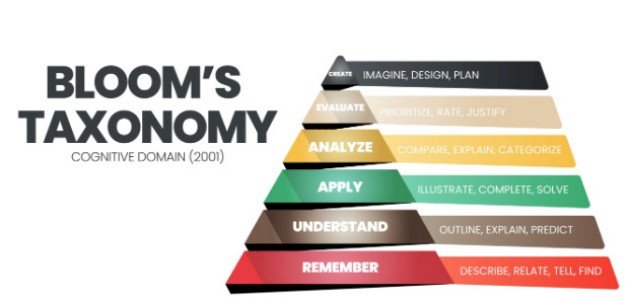
Each category contains subcategories that progress from simple to complex and from concrete to abstract. The five categories following knowledge are considered skills and abilities, with knowledge being a necessary prerequisite for applying these competencies.[2] The first three categories represent lower levels of cognition and learning, while analysis, synthesis, and evaluation reflect higher-order thinking skills. This hierarchical structure is often visualized as a pyramid.[1]
Bloom's Revised Taxonomy
A team led by Lorin Anderson, a former student of Bloom, and David Krathwohl, a colleague of Bloom who was part of the original development team, reviewed and updated Bloom’s educational objectives taxonomy, producing a more dynamic and refined version.[1]
The revised Bloom’s taxonomy serves as a framework for learning, teaching, and assessment. In this updated version, three categories were renamed, and all categories are now expressed using action verbs, resulting in the six cognitive processes: remembering, understanding, applying, analyzing, evaluating, and creating.[1]
Based on the above, three key differences between Bloom’s original and revised taxonomies can be summarized as follows:
- The revised taxonomy uses action verbs instead of nouns, enhancing clarity and emphasizing that these cognitive abilities are actively applied rather than passive states.[4]
- The skill of synthesis was removed and replaced with creativity as the highest level, reflecting the view that creativity represents the most complex cognitive skill and the pinnacle of intellectual achievement.[5]
- Other adjustments were made to the hierarchy, particularly reversing the order of the top two levels—this suggests that critical evaluation must precede the ability to create something new.[6]
It should be noted that the original Bloom’s taxonomy and the revised version (often attributed to Anderson) are closely related, and the latter is sometimes mistakenly referred to as Bloom’s taxonomy, though the reverse is never true.[4]
What Is Bloom’s Taxonomy?
Bloom’s Taxonomy is a classification system that defines different levels of human cognition, helping distinguish between thinking, learning, and understanding. Educators have used it to guide the development of assessments, measuring how much students have learned and achieved. It has also been used to shape curricula, including units, lessons, projects, and activities, as well as instructional strategies such as question design.[7]
Bloom’s Taxonomy has helped researchers and teachers understand fundamental ways knowledge and skills are acquired, and has prevented redundant or unnecessary efforts in developing multiple tests to assess the same educational goals.[7]
Proposed by psychologist Benjamin Bloom and his colleagues in 1956, the taxonomy was later revised in 2001 by Anderson and Krathwohl, who introduced an updated and refined version. Bloom’s Taxonomy has been widely applied in teaching across generations of educators, from early childhood education through high school and college-level instruction.[9]
References
- ^ 1 2 3 4 "BLOOM’S TAXONOMY", edglossary, 3/5/2014, Retrieved 30/1/2022. Edited.
- ↑ "WHAT IS BLOOM’S TAXONOMY?", bloomstaxonomy, Retrieved 30/1/2022. Edited.
- ↑ Invalid citation: The
<ref> tag is incorrect; no text was provided for the reference named 5d555dd8_659e_4546_ad1f_901fa51c5abe
- ^ 1 2 3 "Design and teach a course", unisa, Retrieved 30/1/2022. Edited.
- ↑ TeachThought Staff, "Bloom’s Taxonomy Is A Hierarchical Framework For Cognition And Learning Objectives", teachthought, Retrieved 30/1/2022. Edited.
- ↑ Sujit Pal (28/9/2018), "How is the revised blooms taxonomy different from earlier taxonomy?", quora, Retrieved 30/1/2022. Edited.
- ^ 1 2 "BLOOM’S TAXONOMY", edglossary, 3/5/2014, Retrieved 30/1/2022. Edited.
- ↑ "Bloom's Taxonomy", york, Retrieved 30/1/2022. Edited.
- ↑ Patricia Armstrong, "Bloom’s Taxonomy", vanderbilt, Retrieved 30/1/2022. Edited.